
Microservice Architecture
On the software implementation level, IREX can be considered an aggregation of microservices interacting with each other according to the simplified scheme below:
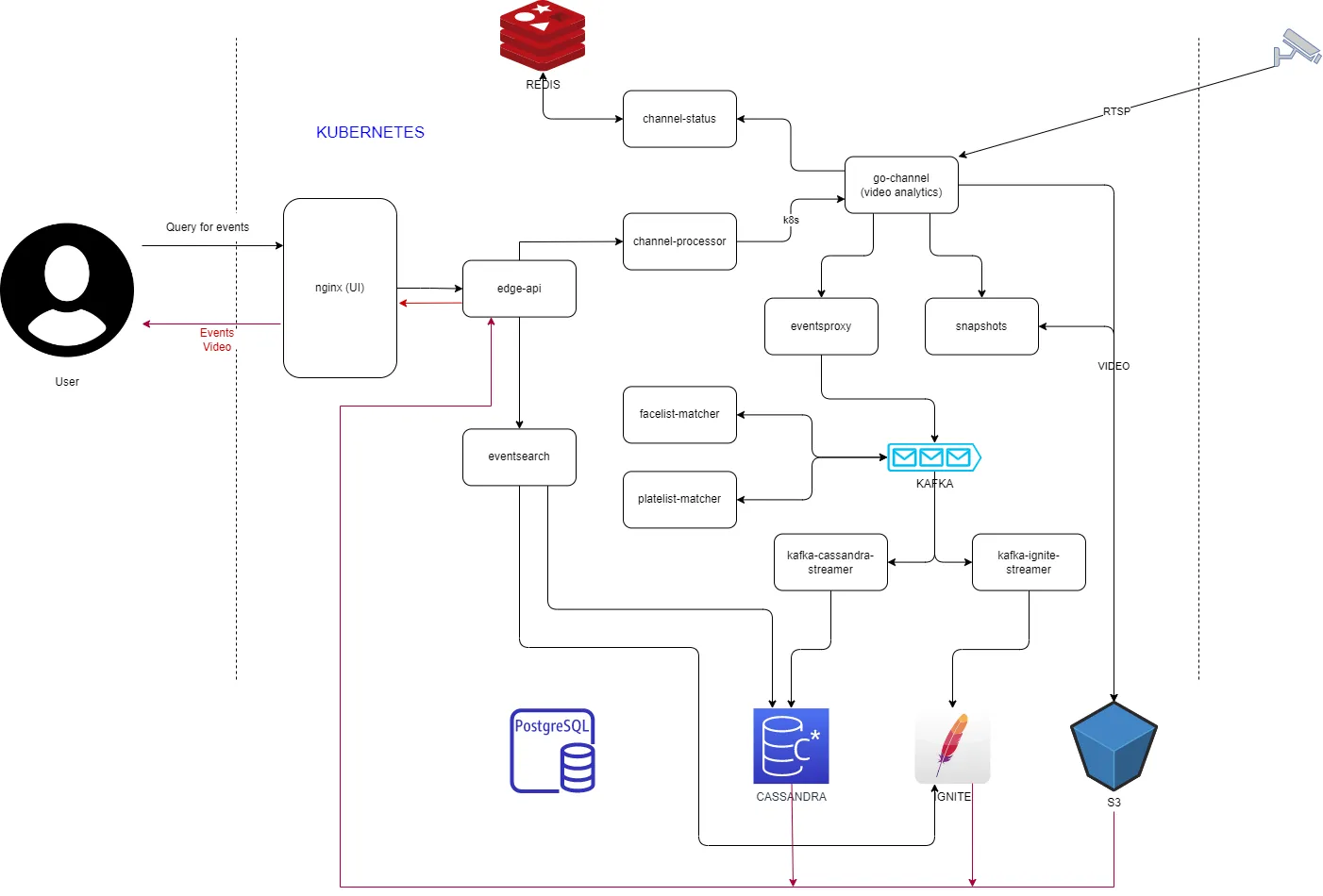
The diagram uses earlier service names: channel-processor corresponds to channel-manager, and eventsproxy corresponds to va-events-receiver.
Here, the two basic sub-platforms can be outlined:
- Private Cloud
- Smart City
The cloud-native architecture like this exploits the flexibility, scalability, and resilience of cloud computing to allow secure, resilient, and easy deployment in any datacenter or on-prem location.
Secure Cloud
The Secure Cloud runs 100% open-source software to supply the following services to the Smart City:
Cassandra
Stores analytics events, JPEG event frames, and archive-part metadata. The metadata identifies each video part and its S3 object key; video bytes are stored in S3-compatible object storage.
Redis
A resident NoSQL database system storing Key-Value pairs relevant to channel statuses and authentication sessions; used as a fast-access cache.
Kafka
Distributed message broker between all the other microservices.
S3
Stores recorded video as fragmented MP4 (fMP4) parts, uploaded gallery files, and exported archive files. JPEG event frames are stored in Cassandra.
PostgreSQL
Relational database inside Kubernetes to supply various information to all the other components.
The Smart City
The Smart City sub-platform implements data processing based on K8S (Kubernetes).
K8S (Kubernetes) is a system for deploying and managing (orchestrating) docker containers, providing mechanisms for self-recovery, performance verification, task re-planning, and load balancing during data processing. Its main task is to run the container on server hardware with sufficient resources (CPU, RAM). Available resources are counted based on the requested resources in the POD and the server capacity. Kubernetes automatically restarts the application when it crashes. When a Kubernetes machine crashes, the containers are migrated to available machines.
Channel-Status Checker
Checks channel statuses to display those graphically on the map.
Inputs channel ID list.
Outputs channel status (optionally - reason for it, e.g. status = unhealthy, reason = FrameRateTooLow).
Channel Manager
Creates, updates, and removes gochannel pods according to the channel configuration stored in PostgreSQL.
Inputs requests to update the channels.
Outputs the updated channel list.
API Edge-API
Processes HTTP requests from the users sent via the web interface to respond with the processing results.
Kx-Channel Analytics Module
Implements video input, processing it with video analytics to generate events archiving those and other major functions.
Inputs user's commands, such as "Set reference frame", "Reload video analytics settings", etc.
Outputs events and event snapshots.
Event Receiver
The va-events-receiver service receives analytics events through va-api-gateway and publishes them to Kafka. Video recording is a separate path: gochannel writes fMP4 parts to S3-compatible storage.
Receives batches of analytics events from the channel runtime.
Outputs event messages.
Snapshots Microservice
Stores JPEG event frames in Cassandra and retrieves them on request.
Inputs requests for snapshots.
Outputs the snapshots.
Facelists-Matcher Module
Compares calculated face descriptors against those enrolled in the database.
Inputs detected face descriptors.
Outputs the "Match <...>" events.
Platelists-Matcher Module
Compares detected plate numbers against those enrolled in the database.
Inputs detected plate numbers.
Outputs the "Match <...>" events.
API Eventsearch
Implements the search for user-defined events in the database.
Inputs query for events conditions.
Outputs the events.
Kafka-Cassandra-Streamer Microservice
Dispatches full event messages to Cassandra.
Inputs event messages from Kafka.
Outputs events saved to Cassandra.
Kafka-Ignite-Streamer Microservice
Dispatches event metadata messages to Ignite.
Inputs event messages from Kafka.
Outputs event metadata saved to Ignite.
Extras
Additionally, there are services and utilities implemented on the Smart City sub-platform yet not shown on the scheme. The most important of them are:
Alarm-Monitor
The service to manage alarm monitors.
Archive-Streamer5
Streams the requested video fragments on the UI.
Authentication-Server
Implements user authentication to provide access according to their roles.
Descriptor-Extractor
The neural network to calculate face descriptors.
Descriptor-Updater
Updates a face descriptor if a more similar match is found in the database.
Downloader
Downloads user-defined video fragments to the local files.
Edge-to-Cloud-Connector, Edge-from-Cloud-Connector
Gates to communicate with kx-channel through edge-api.
Ignite-Cleaner
Cleans the outdated entries in Ignite database
Ignite-Instance
The Ignite database instance to store event metadata.
Ignite-Tools
Ignite management script storage.
Kafka-Init
Creates message topics in Kafka.
License-Postgres
License to the platform database.
License-Server
The server to manage licenses (issue, update, terminate).
PTZ
PTZ camera control (rotate, shift, zoom).
Raw-Video-Channel-Processor
Creates a channel for a video uploaded from an external file.
Seclog
Complete logging of major system performance events, including who did what, in full detail to ensure transparency and responsibility principles as CJIS and GDPR stipulate.
Stream-Info
Video stream properties provider (resolution, bitrate, etc.).
SQL-Migrations
The PostgreSQL migration tool.
Sync-Event-Streamer
Passes PostgreSQL entry messages to Kafka.
VA-Event-Processor
The neural network to detect appearance features, such as beard, glasses, mask or no mask.
Edge Server Architecture
Edge server architecture allows the video analytics resources to be deployed on edge servers located close to the cameras on a remote site.
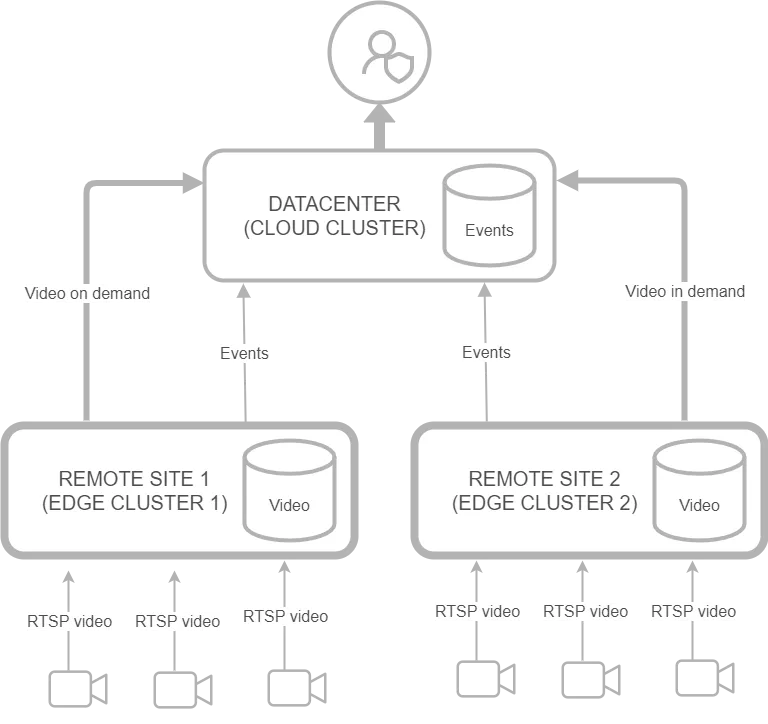
The basic idea is that with video analytics executed directly on the remote site, there is no need to transmit the entire raw video stream from the cameras into the cloud via a broadband TCP-IP link; only the analytics products - events, which are of major concern for the end-user - can be transmitted making the traffic much smaller and easing the bandwidth requirements. Of course, whenever queried for, video can be transmitted to the data center; however, on-demand transmissions take much less traffic than the continuous one.
The table below gives a summary of cloud-based analytics versus edge server-based one in order to prove the edge server solution is less resource-consuming as for bandwidth and hardware yet more robust to disruptions on the Internet and tough external conditions (humidity, air purity in server rooms).
| Feature | Cloud-Based Analytics | Edge Server-Based Analytics |
|---|---|---|
| Real-time alerts for control rooms and fusion centers | YES | YES |
| Multi-site Searchveillance™ | YES | YES |
| Reduced bandwidth | NO | YES |
| Offline video analytics and recording | NO | YES |
| Automatic event synchronization upon network recovery | NO | YES |
| Centralized management | YES | YES |
| High availability, load balancing, fail-over | Included | Extra cost for on-prem hardware |
| Video and event encryption | YES (VPN required) | YES (automatic VPN) |
| Automatic software updates | YES | YES |
| Automatic camera discovery | NO | YES |
The solution can be recommended wherever lower bandwidth matters, Internet disruptions seem likely, and/or external conditions are tough. If this is the case, order a calculation from the Platform representative of what hardware the edge server-based solution needs, and an estimate of costs.
If implemented, the edge servers can then be managed.